
Surya Namaskar – A Short History
Surya Namaskar – a Short History
The sun has always been an object of worship since time immemorial. Not only in India, but in Greece, Egypt, Scandinavia. In fact, probably every indigenous culture probably had their version of sun worship.
In Rigveda 1.115, one of the most often-recited verses of Sūrya worship, just as Sūrya yokes his horses to initiate dawn, pious men are said to engage in “yoking” the sacrifice. Hence, the sun and ritual have always had a close bond.
Indeed, salutations to the sun are related to the performance of the Gayatri mantra at dawn in the traditional Brahmanical (Sandhya Vandanam) rituals for daily life. Similarly, the performance of ritual prostrations by Brahmin priests (and public) in front of the temple-alters has probably always been a feature of worship.
Elliot Goldberg in his book Modern Path states:
“It might also be noted that the worship of Sūrya was historically well-represented in Maharashtra, a region critical in the development of modern Indian physical culture, in part due to the pervasive influence of the Smārta pañcāyatana mode of ritual, which included Śiva, Viṣṇu, Devī, Gaṇeśa, and Sūrya as the principal objects of worship”.
One theory is that it’s modern origins have been traced back to Shivaji, the hero-warrior much valued in Indian history as having established the state of Maharashtra (1630-1680). Wherein, his guru Ramdas (1608-1682) promoted ritual practice of Surya Namaskar (SN) in numerous akharas (wrestling gymnasiums) throughout the state.
On the other hand, cultural anthropologist Joseph S. Alter has suggested that SN has its roots in the dands and betuks of Indian Wrestling and not the other way around.
Either way, the practice of SN has always been indubitably linked with the Hindu tradition. Often touted as a ‘complete’ practice of mind-body-spirit and often encouraged (not without controversy) on a state level, particularly in school-education systems.
Swami Kuvalayananda was an early promotor of the SN. Although he later was to change his mind, earlier he would advocate its practice as “an entire system of physical culture”. Latterly, he was to advise separating the practice of yoga asana with SN as two different traditions (and famously criticised Krishnamacharya for not doing so).
Mark Singleton in his book Yoga Body argues that by 1933 when Krishnamacharya first started teaching yoga at the Jagamohan Palace in Mysore, SN and the practice of asana was already commonly fused together.
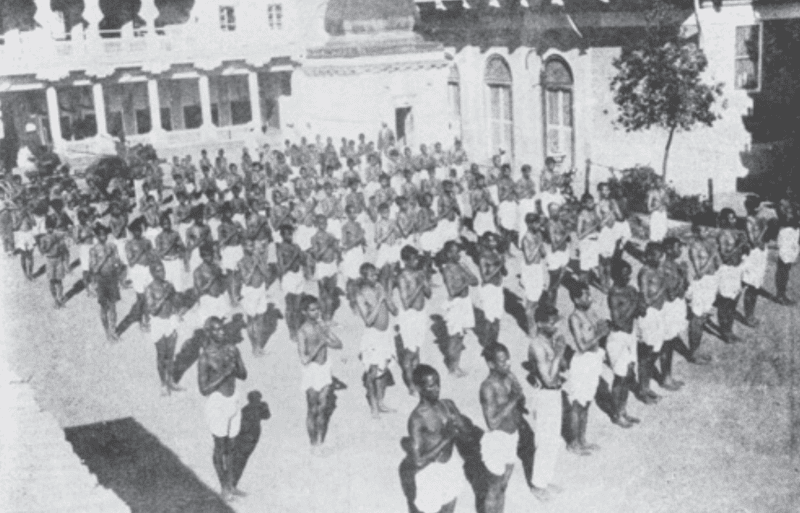
However, the Mysore government was the first to take up the cause of indigenous physical culture as early as 1919, and records show attendance of SN classes as well as yoga (asana) classes. So, along with Kuvalyananda’s criticism, this seems unlikely.
On the other hand, he does suggest that the maharajah charged Krishnamacharya with inventing a kind of “crossover” yoga that would appeal to the masses. Something that does appear more likely.
Bhavan Rao Pant, the Raj Of Aude might be referred to as the “Father of the Modern Sun Salutation”. He has been credited with making the movements more challenging, along with secularising the practice in his ground-breaking work the ten point way to health (1928) along with Louise Morgan in the UK.
Louise massively popularised the SN in the UK as as system of fitness, particularly to the female middle-classes. This involved the secularisation of SN which, for example, Pant practiced with mantras. Instead, she promoted a general body-awareness, sewing the roots of this in modern postural practices.
Similar to his predecessors, Pant considered the SN to be a complete system of mind-body fitness;
“performing surya namaskar…you will know more about yourself than years of jungle-hunting or dealing with international affairs, big business or worldly success would ever give you.”
He In his book Surya Namaskars he claims to have learned the sūryanamaskār in 1908. Pant also claimed that his father practised the sūryanamaskār for fifty-five years, which would date that particular example of the practice of SN as far back as at least the 1870s.
In advocating indigenous physical activities, Bhavana Rao, Kuvuyalanada were implicitly condemning the practice of Western physical activities in India. In this, they were part of the growing wave of nationalist spirit in India. Indeed, Pant says:
“There will shortly be produced a type of humanity that shall excel in body, mind and soul any that the earth has yet brought forth and shall set a new standard for the race.”
Certainly, in its synchronised performance and the attempt to have the SN included in compulsory school education, it does appear that its usage has certainly been used politically in the modern period (as perhaps it always has been).
Elliot Goldberg suggests the popularity of SN to equally be representative of modernity most generally which has “an unprecedented fascination with human movement”.
Subsequently, the practices of SN have been further popularised by the forerunner of the modern yoga tradition; Pattabhi Jois, BKS Iyengar and Swami Sivananada.
Sivananda claims, not unusually by now, that; “Suryanamaskaram combines the benefits of vigorous physical exercise and Yoga Asanas. “
In the more recent times, the SN has again been again the forefront of political propaganda with the performance of SN on International yoga day by Narendra Modi and Ramdev. In fact, as a tableau that meets the visitor to India at Delhi Airport, the SN is deeply rooted at the heart of modern (Hindu?) identity.
